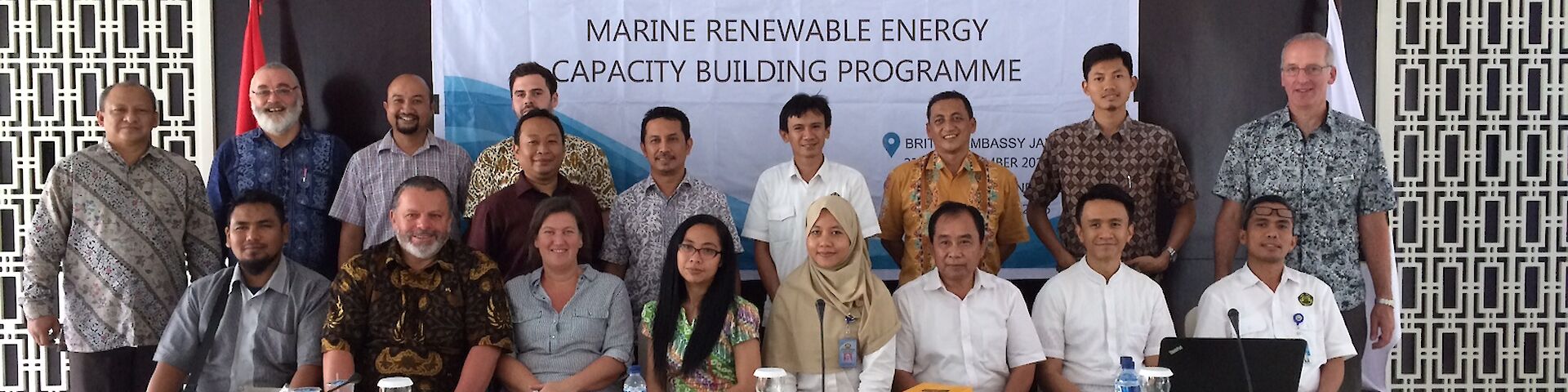
Education, Training, Capacity Building and Public Awareness
Aquatera's expertise in Education, Training, Capacity Building and Public Awareness extends to Curriculum Development, ensuring the tailored creation of materials and courses. We excel in Training Needs Assessment, pinpointing specific learning requirements for organisations or individuals.
As a specialist environmental and energy consultancy with over twenty-five years delivering offshore and onshore renewable energy, environmental impact assessment, marine planning and community resilience, we bring extensive experience across sectors.
As the global energy transition landscape shifts from policy commitment to active execution, Aquatera has also developed our core technical expertise into a high-value institutional capacity-building service. We recognise that technical deployment alone is insufficient without the institutional readiness and human capital required to manage and regulate innovative energy systems.
Operating from our headquarters in the Orkney Islands, which are recognised globally as a "living laboratory" for offshore renewable energy, Aquatera provides a unique bridge between technical innovation and implementation reality. Our global footprint extends across the UK, Europe, Southeast Asia, the Pacific Islands and South America, supporting governments, development finance institutions and multinational energy companies in navigating the complexities of the energy transition.
Our Team
Aquatera’s team is multidisciplinary and multisectoral, with staff whose expertise spans the full lifecycle of sustainable infrastructure. Our team members have diverse academic and professional backgrounds, including engineering, environmental science and social science disciplines. This allows us to approach challenges through a systems-thinking lens. Our diversity allows us to provide technical leadership that is as rigorous in engineering specifications as it is in environmental stewardship and social safeguards.
Our staff’s extensive geographical experience has cultivated deep-rooted sensitivity and adaptability to varied organisational, sectoral and cultural landscapes. We specialise in navigating the implementation reality gap where national strategy meets the site realities - particularly in archipelagic, coastal and remote communities.
Our INSPIRE! Framework
Aquatera delivers sector-embedded learning anchored in our proprietary INSPIRE! Framework – a participatory, place-based and reflective model designed to build transformative knowledge systems rather than one-off knowledge transfers.
Renewable Energy
Aquatera’s technical competence covers the full blue-green spectrum, with a distinctive specialisation in coastal, island and marine environments.
Marine Renewable Energy: We hold one of the sector’s deepest track records in tidal and wave energy and offshore wind, leading strategic site selection, resource assessment and Environmental and Social Impact Assessments (ESIAs).
Marine Floating Photovoltaics (FPV): We are leading inclusive innovation in marine floating solar, currently through an ongoing programme that integrates technical FPV deployment with community-led resilience.
Decentralised Renewable Energy Systems: We specialise in small-island grid integration and off-grid solutions, using toolkits to adapt global technology pathways to the specific constraints of archipelagic and remote settings.
Energy Transition and Decarbonisation
Aquatera supports the development of energy transition governance, local business models, and institutional readiness required to move energy transitions from strategy to execution.
Strategic Roadmapping and Governance: We deliver energy transition strategies, net zero pathways and emissions baselining in collaboration with national utilities and energy ministries.
Just Transition and Workforce Readiness: Our methodology integrates Just Transition principles, addressing the socio-economic impacts of energy systems and the redistribution of energy benefits across diverse regions and income levels.
Carbon Management and Decarbonisation: We have advanced skills in carbon management planning, lifecycle analysis (LCA) and technology matching, supporting nationwide projects in diverse geographies, as well as the Islands Centre for Net Zero (ICNZ) in Scotland.
SDG and Sustainable Development
Aquatera treats Sustainable Development Goal (SDG) alignment as a core design principle in our services rather than as a compliance requirement.
GEDSI Mainstreaming: We integrate Gender Equality, Disability, and Social Inclusion (GEDSI) across our programmes
Circular Economy: We embed circular economy thinking and environmental stewardship into energy-system lifecycles, focusing on reducing the environmental footprint of transition technologies.
Climate Resilience: We provide advice on blue carbon roadmaps and sustainable aquaculture, aligning marine resource management with climate resilience.
Institutional Capacity Building
Aquatera provides sector-embedded, high-value institutional capacity building designed to deliver not just knowledge transfer, but transformative knowledge systems. Our technical competence in Capacity Building is anchored in the following.
Curriculum Co-design: utilisation of participatory approach to ensure learning pathways are tailored to the specific needs, capability gaps, and site realities
Material Co-development: modular toolkits, interactive slides and GEDSI-mainstreamed content, adapted from our global repository and aligned with Indonesian regulatory and operational standards.
Training Workshop Co-delivery: a flexible hybrid delivery model combining asynchronous, self-paced learning with structured, synchronous support, underpinned by dedicated digital platforms that act as repositories for knowledge products and hubs for knowledge processes, including discussion forums and real-time MEL dashboards.
Immersive Action Learning: methods that move beyond theoretical knowledge transfer to bridge the gap between national planning and archipelagic implementation realities, providing practitioners with field-based immersion and participatory site-visit learning that enables them to navigate the cultural and operational realities needed for complex energy transitions.
Peer Learning: facilitated, structured interaction between peers designed to enable exchanges of tacit knowledge: the learned experience and commitment to delivery that are often lost in traditional training.
Communities of Practice (CoP): active online platforms for continuous knowledge processes, hosting repositories of localised case studies alongside manuals and templates to ensure energy-agency knowledge remains embedded within organisations’ governance and decision-making structures.
Training of Trainers (ToT): comprehensive modules equipping local instructors with the technical authority to lead future cohorts and providing recognised micro-credentials to validate institutional capability
Certification: Aquatera’s INSPIRE! Framework brings proven credentials, having been implemented for and recognised by leading international organisations and development programmes, including the United Nations Office for Project Services (UNOPS), the International Maritime Organization (IMO) and the UK Programme for Accelerating Climate Transitions (UK PACT). Locally, we have worked with our in-country key government partner, the Human Resources Development Agency of the Ministry of Energy and Mineral Resources (PPSDM MEMR), including the provision of micro-credentials and digital acknowledgement, allowing participants to gain shareable professional recognition for their upskilling.